Truck Scales in Texas – Why Texas Oilfield, Agriculture & Freight Operations Need Reliable American-Made Truck Scales
November 25, 2026 8:22 pmWhen you’re managing an oilfield operation in the Permian Basin, moving cattle across a Texas ranch, or coordinating freight shipments through Houston, accurate truck weights are an essential part of keeping business moving. Every load represents valuable material, transportation costs, and operational responsibilities, which means unreliable weighing equipment can create problems that extend well beyond the scale itself. Add Texas heat, dusty industrial sites, heavy equipment traffic, and changing weather conditions, and it’s easy to understand why durability matters just as much as accuracy.
The best truck scales in Texas combine heavy-duty construction, appropriate weighing capacity, dependable electronics, and professional installation. Oilfield operations, agricultural businesses, and freight facilities have different requirements, so selecting equipment involves evaluating vehicle configurations, daily traffic, site conditions, and whether the scale must meet legal-for-trade standards. Ongoing inspection, calibration, and maintenance also play important roles in keeping weighing systems reliable.
Here’s what Texas operators should consider:
- Industrial conditions vary across the state: Oilfield equipment in Midland and Odessa faces different working conditions from freight terminals in Dallas-Fort Worth or agricultural facilities in the Texas Panhandle.
- Accurate weights support operations: Reliable measurements help businesses manage material quantities, shipment records, and vehicle loading.
- Commercial scales have regulatory requirements: Texas businesses using qualifying scales for commercial transactions must follow applicable registration and inspection rules.
- Heavy-duty construction matters: Repeated loading, outdoor exposure, and abrasive materials can place significant demands on scale structures and components.
- Maintenance protects long-term performance: Regular testing and inspection can help identify worn load cells, damaged wiring, and other developing problems.
At Rockwell Scales, we’ve been manufacturing American-made weighing equipment since the early 1980s, building on more than four decades of industry experience. Although our manufacturing roots are in Montana, we supply heavy-duty truck scales nationwide, including Texas, with custom fabrication, professional installation, calibration support, and maintenance services designed around demanding commercial applications.
Why Are Heavy-Duty Truck Scales Important for Texas Businesses?
Heavy-duty truck scales are important for Texas businesses because oilfield materials, agricultural commodities, construction supplies, and freight shipments often involve substantial loads that must be weighed accurately. For operators throughout Houston, Dallas-Fort Worth, and West Texas, reliable scales help support inventory management, billing, transportation planning, and consistent daily operations.
Accurate Weight Measurements Support Business Decisions
Imagine running a busy aggregate yard where dozens of trucks arrive throughout the day. Each vehicle may be carrying a different quantity of material, and accurate measurements are essential for documenting what enters or leaves the facility.
Oilfield service companies face similar concerns when moving bulk materials, while agricultural businesses rely on weighing equipment to manage grain, livestock, feed, and other commodities.
A dependable truck scale helps reduce uncertainty in these transactions. It also provides information that fleet managers can use when reviewing vehicle loads before transportation.
Texas Working Conditions Demand Durable Equipment
Texas presents a wide variety of industrial environments. Equipment operating in the Permian Basin may encounter dust, heavy loads, and long periods of hot weather, while facilities near the Gulf Coast face humidity and moisture exposure.
Truck scales in rural agricultural regions may also experience concentrated traffic during harvest or livestock shipping periods. These conditions make proper structural design, component protection, and preventive maintenance important.
For operations evaluating heavy-duty truck scales in Texas, selecting equipment built for frequent use can help support reliable performance over time.
Which Truck Scales Work Best for Texas Oilfield, Agriculture, and Freight Operations?
The best truck scale for a Texas operation depends on the vehicles being weighed, expected load capacity, traffic volume, and installation environment. Oilfield facilities may need high-capacity industrial scales, agricultural operations may prioritize livestock or grain weighing, and freight terminals often require efficient truck processing and accurate documentation.
Oilfield and Energy Operations
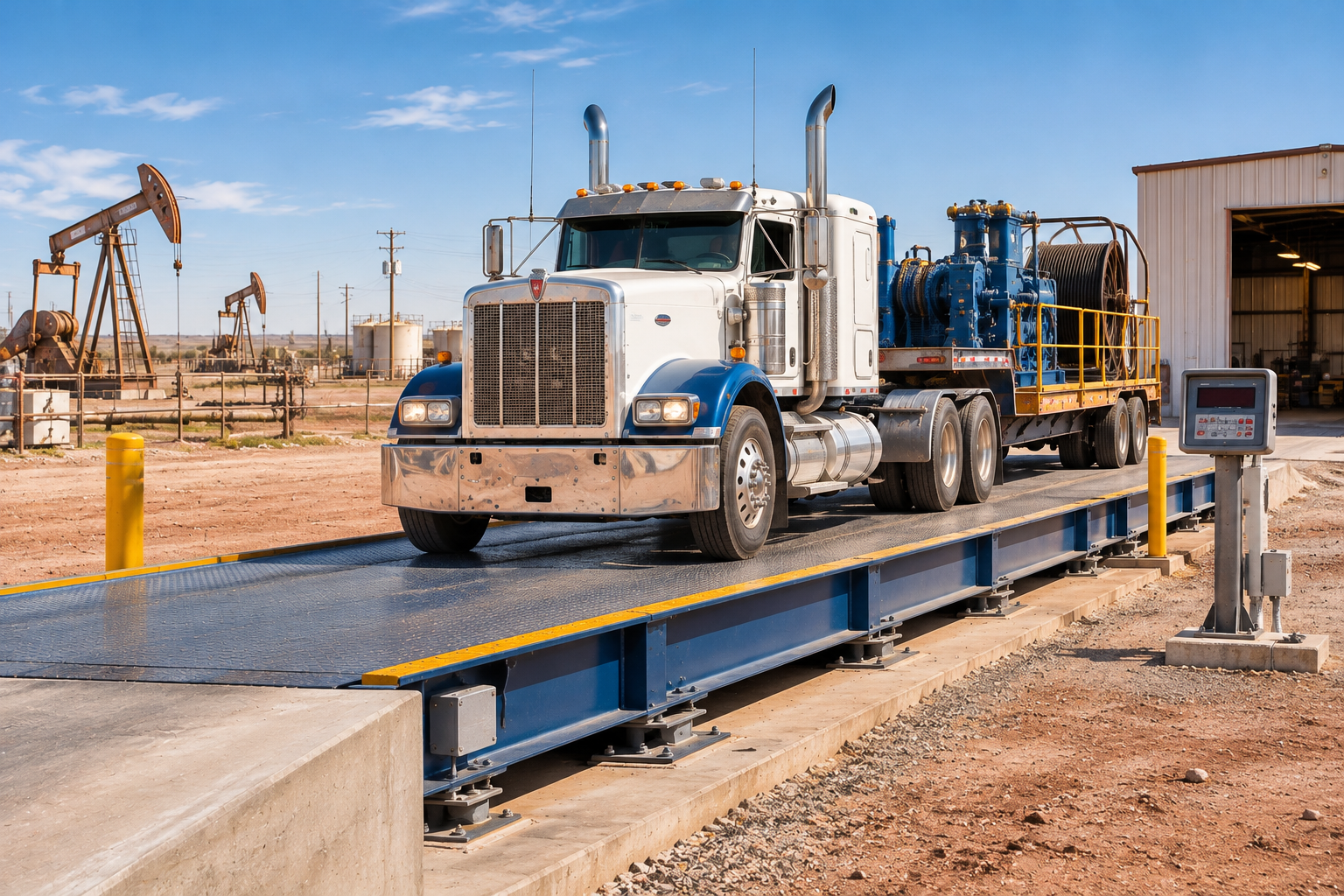
Oilfield businesses in Midland, Odessa, and surrounding Permian Basin communities often handle heavy equipment, bulk materials, and frequent transportation activity. The right weighing system must accommodate the intended vehicles while remaining dependable under demanding conditions.
Industrial truck scales for oilfields may require reinforced decking, high-capacity load cells, and customized dimensions. Appropriate site planning is also important when equipment operates around dust, vibration, and heavy machinery.
We manufacture industrial weighing systems that can be configured around these requirements, including our Hulk Series and Crusher Series.
Agriculture and Livestock Operations
Texas agriculture includes cattle ranching, grain production, feed operations, and numerous other activities requiring accurate measurements. A ranch in the Panhandle may need livestock and truck weighing capabilities, while a grain facility may prioritize efficient vehicle throughput during harvest.
Our agricultural offerings include livestock scales, truck scales, hopper scales, and custom configurations. We evaluate the vehicles, materials, and available space before recommending a suitable system.
Transportation and Freight Facilities
Freight operations near Houston, Dallas-Fort Worth, and San Antonio depend on accurate weights to support load planning and shipment documentation. Busy logistics facilities also need scales that can handle repeated vehicle traffic without creating unnecessary delays.
Optional equipment such as remote displays, printers, and automated ticketing systems can help support efficient weighing procedures. We can discuss accessories and configurations based on the facility’s existing operations.
What Makes American-Made Rockwell Truck Scales Different?
Our American-made truck scales combine reinforced construction, customized configurations, and long-term service support for demanding industrial applications. With more than 40 years of experience, we manufacture equipment intended for repeated heavy loads and back our structural design with a 20-year structural warranty.
More Than Four Decades of Manufacturing Experience
Our company has been involved in the weighing industry since 1980, with a history rooted in agricultural and industrial scale installation. Over the years, we’ve expanded from serving regional customers to providing weighing systems throughout the United States.
That experience informs how we evaluate scale construction, site conditions, and long-term equipment needs. Rather than assuming the same configuration works for every business, we consider the demands of each application.
An Industry-Leading Structural Warranty
Our manufactured scales carry a 20-year structural warranty, which we identify as the longest in the industry. We also report no structural failures across our manufactured scales.
These claims reflect our emphasis on durable construction, although customers should review the written warranty terms for applicable conditions and exclusions.
For Texas companies making a substantial equipment investment, long-term structural support is an important consideration when comparing manufacturers.
Hulk Series vs. Crusher Series: Which Truck Scale Fits Your Operation?
The Hulk Series and Crusher Series offer different deck constructions and capacities for heavy-duty weighing applications. The Hulk Series uses reinforced steel decking, while the Crusher Series features a reinforced concrete deck, giving Texas operators options based on load requirements, installation preferences, and working conditions.
Hulk Series: High-Capacity Steel Deck Construction
Our Hulk Series features reinforced three-eighths-inch steel decking and a capacity of up to 270,000 pounds. This heavy-duty design is intended for demanding industrial environments where repeated truck traffic and substantial loads are expected.
The series offers legal-for-trade configurations and high-accuracy load cells for commercial weighing applications. For Texas freight facilities, material yards, and oilfield operations, it can be an option when high-capacity steel construction fits the site.
Crusher Series: Reinforced Concrete Deck Construction
Our Crusher Series offers a capacity of up to 100 tons and features a five-inch reinforced concrete deck. These fully electronic, NTEP-approved scales are assembled and poured on-site.
Concrete deck construction may appeal to operations seeking a reinforced weighing surface for frequent heavy traffic. Installation requirements differ from steel-deck systems, making site planning important.
| Hulk Series | Crusher Series |
|---|---|
| Reinforced steel deck | Reinforced concrete deck |
| Up to 270,000-pound capacity | Up to 100-ton capacity |
| Three-eighths-inch steel decking | Five-inch reinforced concrete deck |
| Heavy-duty industrial applications | Heavy-duty industrial applications |
| Legal-for-trade options | NTEP-approved configurations |
We can help you compare the two systems and determine whether a standard or customized configuration best matches your operation.
When Should You Consider Portable or Axle Truck Scales?
Portable truck scales and axle scales are worth considering when a facility needs flexible weighing arrangements or additional information about vehicle weight distribution. For Texas contractors, temporary oilfield projects, and agricultural operations, these systems may provide alternatives to certain permanent installations.
Portable Scales for Changing Job Sites
Portable truck scales can be useful for temporary projects, seasonal operations, or facilities that may need to relocate equipment. Their flexibility can be particularly valuable for construction and industrial projects operating at multiple locations.
However, portability doesn’t eliminate site preparation or calibration requirements. The weighing system still needs appropriate support, setup, and maintenance.
Axle Scales for Weight Distribution
Axle scales measure individual axles or axle groups and help operators evaluate how a load is distributed across a vehicle. This information can be useful when reviewing loading arrangements or preparing equipment for transportation.
For fleet managers throughout Texas, axle measurements can supplement other weighing information. However, not every portable or axle scale configuration is approved for commercial transactions, so the intended use must be established before purchase.
What Are the Texas Truck Weight Regulations?
Texas truck weight regulations establish limits for gross vehicle weight, individual axles, and axle groups, with additional requirements determined by vehicle configuration, route, and applicable permits. Truck scales help operators obtain weight measurements, but compliance also depends on axle spacing, tire ratings, road restrictions, and other legal conditions.
According to the Texas Department of Motor Vehicles, general maximum weights for many vehicles operating without special permits include:
- Gross vehicle weight: 80,000 pounds.
- Single axle: 20,000 pounds.
- Tandem axle group: 34,000 pounds.
These are general limits rather than universal permissions. Bridge formula requirements, vehicle configurations, special permits, and posted road restrictions may establish different applicable limits.
For oilfield carriers and freight companies, checking the relevant route and permit requirements is important before dispatch. Weighing equipment provides measurements, but operators remain responsible for determining whether their vehicles meet applicable transportation regulations.
What Does NTEP Certification Mean for Texas Truck Scales?
NTEP certification means a weighing-device model has been evaluated for conformity with applicable requirements under the National Type Evaluation Program. For Texas businesses purchasing legal-for-trade truck scales, an approved device can simplify equipment selection, but certification alone doesn’t complete the state’s commercial weighing requirements.
The Texas Department of Agriculture oversees commercial weighing devices, including truck scales, under its Weights and Measures program. Businesses operating qualifying commercial scales generally must register the devices and renew their registrations annually.
Texas also requires applicable inspections and compliance with the relevant standards in NIST Handbook 44. Importantly, the state explains that a device can sometimes qualify as legal for trade without an NTEP Certificate of Conformance, although NTEP approval provides recognized evidence of model compliance.
We offer NTEP-certified truck scale options and professional installation support. We recommend confirming the selected model’s approval status and arranging the required Texas registration, service, and inspection steps before commercial operation.
What Should You Expect During Truck Scale Installation in Texas?
Truck scale installation in Texas generally involves evaluating the site, selecting an appropriate scale configuration, preparing the foundation, installing equipment, and testing the system. Oilfield, agricultural, and freight facilities may require different approaches depending on soil conditions, vehicle traffic, drainage, and operational needs.
Site Evaluation and Planning
The installation process begins by understanding which vehicles will use the scale and how frequently they will be weighed. Platform length, width, capacity, and vehicle approach areas must support the intended operation.
For Texas facilities, drainage and soil conditions also deserve careful attention. Heavy rainfall, soil movement, and high vehicle traffic can affect the performance of an improperly prepared installation.
Equipment Placement and Configuration
After the site is prepared, the scale is assembled and positioned according to its design. Load cells, wiring, indicators, and other components must be installed correctly for dependable operation.
Our professional installation services include equipment setup, configuration, and operational testing. Custom fabrication is available for unusual dimensions, capacities, or site layouts.
Calibration and Commercial Readiness
Once installation is complete, the equipment must be tested and calibrated as appropriate. Commercial operations must also meet applicable Texas Weights and Measures requirements before using the scale for qualifying transactions.
Our team can discuss these considerations during planning, helping customers understand the steps involved in preparing their equipment for service.
What Warning Signs Indicate Your Truck Scale Needs Maintenance?
Common warning signs that a truck scale needs maintenance include inconsistent readings, difficulty returning to zero, visible platform damage, and recurring electronic errors. For Texas operations handling heavy loads, identifying these concerns early can help limit downtime and reduce the risk of inaccurate measurements.
Watch for these problems:
- Inconsistent weight readings: Similar loads produce unexpected variations.
- Failure to return to zero: The scale indicates weight after the platform is empty.
- Damaged load cells: Critical measuring components show signs of malfunction or physical damage.
- Wiring deterioration: Connections or cables appear damaged by moisture, heat, or equipment movement.
- Deck damage: Visible structural wear or other deterioration affects the weighing surface.
- Debris accumulation: Dirt, rock, or other materials interfere with normal platform movement.
- Indicator problems: Displays produce recurring error messages or stop responding properly.
A malfunction doesn’t automatically mean the entire truck scale must be replaced. Professional troubleshooting can help determine whether cleaning, calibration, component replacement, or more extensive repairs are appropriate.
How Often Should Truck Scales Receive Professional Maintenance?
Truck scale maintenance should follow a schedule based on equipment type, daily traffic, environmental conditions, and applicable regulatory requirements. Annual professional maintenance is a reasonable starting point for many operations, while high-volume Texas facilities may benefit from additional inspections and testing.
Preventive Maintenance for Demanding Environments
Oilfield sites and aggregate yards often expose scales to dust, heavy loads, and abrasive materials. Regular cleaning and inspection can help identify buildup that interferes with the weighing platform.
Along the Gulf Coast, moisture exposure may create different maintenance concerns. Inspecting electrical components and connections helps identify deterioration before it affects performance.
Calibration and Accuracy Testing
Calibration helps identify whether a scale’s measurements remain within applicable requirements. This is particularly important for businesses using weight information to determine commercial transaction values.
Our maintenance services include inspection, testing, calibration support, cleaning, and repairs. We also offer service contracts for frequently used scales requiring regular attention.
Repairs and Equipment Upgrades
Our technicians service load cells, indicators, electronic components, weigh beams, and scale decks. We also provide mechanical-to-electronic conversions for older weighing systems when an upgrade makes sense.
For operators evaluating truck scale maintenance, the goal should be correcting problems before they create extended interruptions to daily operations.
What Common Truck Scale Purchasing Mistakes Should Texas Businesses Avoid?
Common truck scale purchasing mistakes include selecting inadequate capacity, overlooking site conditions, and assuming all scales are automatically approved for commercial transactions. For Texas operators, these decisions can result in unnecessary costs or equipment that doesn’t match the facility’s actual requirements.
One mistake is choosing a scale based only on its advertised maximum capacity. Platform dimensions, load distribution, traffic volume, and operating conditions also affect suitability.
Another mistake is overlooking drainage, foundation preparation, and equipment accessibility. A durable scale still requires appropriate installation conditions to operate reliably.
Finally, don’t assume that purchasing an NTEP-approved model automatically satisfies every Texas registration or inspection requirement. Commercial readiness depends on the complete installation and applicable state procedures.
A Common Truck Scale Scenario in the Permian Basin
A common Permian Basin scenario involves an oilfield service company near Midland that needs a dependable weighing system for frequent heavy truckloads. The existing equipment has begun producing inconsistent readings, and growing traffic has made downtime increasingly disruptive.
The company might initially consider replacing the entire scale. However, a professional evaluation could identify a repairable load cell problem or determine that a higher-capacity system would better support future operations.
This is an illustrative scenario rather than an actual customer project. It demonstrates why accurate equipment selection begins with evaluating operating requirements and the condition of existing infrastructure.
Why Choose Rockwell Scales for Your Texas Operation?
Choosing Rockwell Scales gives Texas operators access to American-made weighing equipment, custom configurations, and experienced installation and maintenance support. Our manufacturing background, nationwide reach, and emphasis on heavy-duty construction help us serve agricultural, oilfield, freight, and industrial customers with different operating requirements.
We’ve manufactured scales for more than four decades and have supplied weighing systems across the United States and internationally. Our company reports zero structural failures and backs our manufactured scales with a 20-year structural warranty, subject to its written terms.
We serve customers evaluating truck scales in Texas, including operations around Houston, Dallas-Fort Worth, Midland, Odessa, San Antonio, and rural agricultural regions. Our team can discuss equipment selection, shipping, installation arrangements, and ongoing service based on your facility’s location and project needs.
[Request a Free Truck Scale Quote]
Frequently Asked Questions About Truck Scales in Texas
What type of truck scale is best for Texas oilfield operations?
The best truck scale depends on the vehicles, materials, load capacity, and working environment involved. Oilfield facilities near Midland and Odessa may benefit from reinforced steel or concrete deck systems designed for heavy traffic. We can discuss Hulk Series, Crusher Series, and custom configurations according to site requirements.
Are Rockwell Scales truck scales made in the United States?
Yes, we manufacture American-made weighing systems from our Montana operations and supply equipment to customers throughout the country. Our company has more than 40 years of scale industry experience. We also provide installation, calibration support, maintenance, and repair services for qualifying projects.
What is the difference between the Hulk Series and Crusher Series?
The Hulk Series features reinforced three-eighths-inch steel decking and a capacity of up to 270,000 pounds. The Crusher Series uses a five-inch reinforced concrete deck with a capacity of up to 100 tons. Both provide heavy-duty weighing options, but the appropriate choice depends on the installation and application.
Do commercial truck scales need to be registered in Texas?
Yes, qualifying commercial truck scales must be registered with the Texas Department of Agriculture, with registration generally renewed annually. Applicable inspection and accuracy requirements also apply. Businesses should confirm the current requirements for their intended commercial use before putting a newly installed scale into service.
Are NTEP-certified truck scales required in Texas?
NTEP certification is a widely recognized way to establish that a weighing-device model meets applicable standards, but Texas does not universally require an NTEP Certificate of Conformance for every legal-for-trade scale. Commercial equipment must still comply with applicable standards, registration, and inspection requirements.
Can portable truck scales be used at temporary Texas job sites?
Portable truck scales may be useful for temporary construction, agricultural, or oilfield projects where a permanent installation isn’t practical. However, the equipment still requires appropriate setup and testing. Its suitability for commercial transactions depends on the specific model and applicable Texas requirements.
How often should industrial truck scales be calibrated?
Calibration frequency depends on the scale’s usage, operating conditions, accuracy requirements, and applicable regulations. Annual maintenance is a useful starting point for many facilities, while heavily used equipment may require additional testing. We offer calibration support and preventive maintenance programs tailored to different operations.
Does Rockwell Scales install and service truck scales in Texas?
We provide weighing equipment and installation support for customers throughout the United States, including Texas. We also offer calibration, maintenance, and repair services, with scheduling and arrangements based on the project location. Contact us to discuss your site’s requirements and available service options.
Keep Your Texas Operation Moving With Rockwell Scales
From oilfield service companies in the Permian Basin to ranches, grain facilities, construction yards, and major freight terminals, dependable weighing equipment plays an important role in Texas business operations. Choosing the right truck scale requires more than comparing capacity numbers, especially when demanding working conditions, commercial weighing regulations, and long-term maintenance needs all influence performance. At Rockwell Scales, we’ve spent more than four decades manufacturing American-made scales and helping businesses select equipment suited to their applications. Our Hulk Series, Crusher Series, portable options, axle scales, and custom configurations provide solutions for a wide range of industrial needs. We also support our equipment with professional installation, calibration, repair, and maintenance services. Whether you’re expanding your operation, replacing an older scale, or preparing a new facility, we’re here to help you make an informed investment in reliable weighing equipment.
Categorised in: Truck Scales
This post was written by admin